Human rights divided: structural topic modelling of South Korean media coverage, 2017–2022
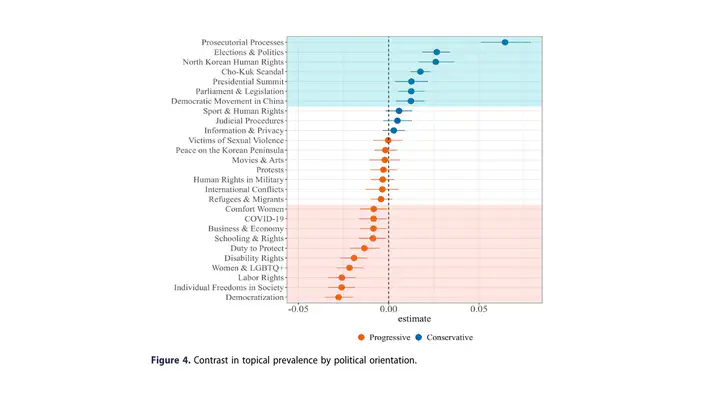 Figure 4. Contrast in topical prevalence by political orientation.
Abstract
While human rights are often regarded as universal and nonpartisan, this article demonstrates how their meanings are contested through domestic media discourse. Drawing on a corpus of 46,262 articles from four major South Korean newspapers—two progressive and two conservative—this study examines how political orientation shapes human rights coverage. Using Structural Topic Modeling (STM), we identify statistically significant patterns of ideological divergence: progressive outlets are more likely to emphasise economic, social, and cultural rights, as well as minority rights, including labour, women’s, and LGBTQ+ rights. In contrast, conservative media show a stronger tendency to focus on civil and political rights, as well as global human rights issues such as procedural protections and North Korean human rights—though progressive outlets devoted greater topical attention to certain civil and political rights, particularly democratic rights. This study advances both empirical and theoretical understandings of human rights polarisation by systematically validating and conceptualising this phenomenon. It situates the polarisation of human rights within broader political, cultural, and technological transformations. It also underscores the importance of examining the consequences of contested human rights discourse—not only as a challenge to normative consensus, but also as a potential catalyst for reflection and renegotiation.